Showing posts with label queen bees. Show all posts

Sunday, October 17, 2010

Nuc and a swarm

It appears that when I made up my latest nuc I didn't select the brood frame very well. Around midday Saturday I noticed a lot of bee activity around a Kowhai tree in the natives corner. Closer inspection revealed a small swarm. I'd be surprised if this swarm lasted very long unaided especially given the cold nights we are having in Christchurch at present I set about collecting it.
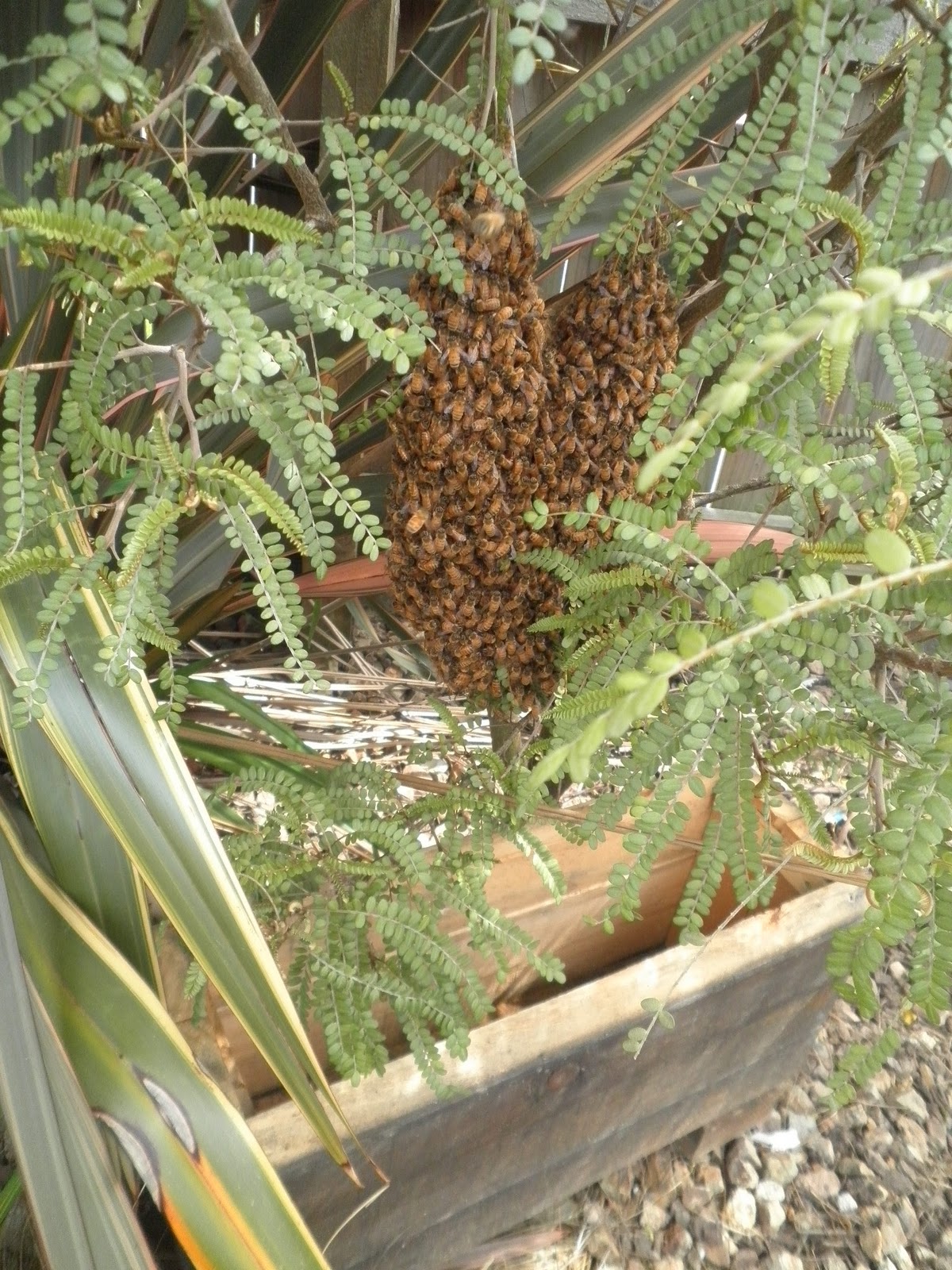
A full inspected of the top bar hive yesterday had revealed no queen cells so the swarm can't have originated from there. The swarm looked too big to have originated from the nuc but that was the only option left. It seemed unlikely that some else's swarm had settled near my hives.

I'm always amazed at the bees ability to communicate. The Queen Substance must be a very strong smell for them. Whenever a swarm is knocked from its perch there is a lot of confusion, bees flying everywhere, but within a few minutes things calm down and the bees collect around the queen again. I placed a nuc box under the swarm, knocked them off and waited. It no time at all order replaced confusion and the majority of the bees were heading in the same direction, into the nuc box.

A queen, seconds after hatching
The nuc was well populated, prior to the swarm, to I took this to mean they wanted more space. I replaced the nuc box with a full depth super and transferred the remaining population, which was still significant, across. It didn't take long to confirm where the swarm had come from. The photo on the left clearly shows several supcedure cells. Most were ripped open but one was in tact. I cut it off and help the queen hatch. She then flew away so I don't know whether she survived or not.

A sheet of newspaper, then a half height box prepared the new hive more merger with the swarm. After dumping the swarm into the half height I slipped the lid on and left them to it. The queens will fight it out I suppose and since they are both new I have no opinion on which one would be better - may the best queen win.

Thursday, February 4, 2010

Queen Bee Graft Progress


There has been some progress on growing the new queens. Cells 1, 4 and 5 have been accepted by the bees. 2 and 3 have been cleaned out. Initially it appeared the bees had accepted all five, which would have been a record for me. The photo on the right was taken on the 1st of Feburary, one day after the graft.
There are bees clustered around all five cells. The photo on the left was taken on the 3rd, cells 2 and three being ignore. Looking back at the images of each graft I'd guess that #2 was rejected because it was quite dry and probably died while it was out of the hive and #3 was part way up the cell wall. The three that were accepted are all in plenty of royal jelly, something to look out for next time I suppose.

In this image the 4 - 5 day old grub can be seen, well surrounded in royal jelly and quite a lot larger than a worker.

Sunday, January 31, 2010

Grafting Queens

As I previously mentioned I'm trying my hand at breeding queens. I'm also aware that the queens in my second apiary are nearing the end of their productive life and I need to replace the queen I sent north, which has arrived and is in good health.

I spoke to the beekeeper I sent the queen and he said they were quite loud when they arrived and to calm them down he wet his finger and let a little water run down the inside of the cage. This calmed them immediately. I hadn't thought about water for them before, but the candy is quite dry. The queen is now in the destination hive so hopefully all is well and the candy has been removed.

Today I grafted 5 grubs into Bozi queen cups. These are plastic cups that make it very easy to transport the queen cells to the nucs or an incubator for hatching. The cups cost about $NZ0.10 each and can be reused. My supplier sells them in bags of 100 so I haven't had to reuse any yet.

This photo shows the top bar of my grafting frame. The white spot marks position #1.

The Bozi cells are secured to the frame by being pressed onto plastic feet. I bought the feet from a plastics supply company and then used short screws to fix them to the frame. Once the cells are capped a gentle twist will remove it from the frame. This also makes it a lot easier to do the graft as the cup can be held in a comfortable position into the grub is place it in.


I use a 'Chinese' grafting tool because that works for me. There are many other tools that people use ranging from a small paintbrush to a flattened bike spoke or coat hanger. It doesn't really matter as long as you can pick up and release the grub. The chinese grating tool has a flexible tounge which is used to pick the grub up and a push button, much like a Bic pen, on its top that is used to push the grub into the cup.

A well fed, healthy hive is much easier to graft from because there will be a large about of royal jelly in the cells with the grubs. This lubricates the pick up and release process so that it becomes a very smooth action. The grubs on the right side of the bee are well fed are ideal for grafting.

Below are photos of each graft I did. Number 3 looks like a bad one but the others seem fine. It will be interesting to see which ones the bees accept.

12
3

4
5

Saturday, January 30, 2010

Honey, but no brood

I visited my second apiary today but forget to take the camera, which was disappointing because there were a few photos I would have liked to have taken.

Before I even opened hive three I knew I was in for some back breaking work. Just tapping on the hive mat (the ceiling) told be it was well sealed and full of honey. Hive one was the same.

The population in hive three seems to be down and it was completely broodless, which is very odd. They have plenty of honey (or had...) and there was also a reasonable amount of pollen in the brood chamber. Even though most of the space was taken up by honey there were still a few frames with mostly empty cells. The weather has been very mixed but the bees have obviously been getting out as evidenced by the amount of stores they have. I sighted the queen and she looked very healthy and large enough to be laying. I removed a full super of honey, including a couple of fully capped frames from the brood chamber, and filled the gaps with some drawn comb. I'll have to pay them another visit in a few weeks and see if the queen has started laying yet.

Hive one was boiling over with bees. I took a three quarter depth super off them and gave them an empty, but drawn, full depth super. They were also broodless, I didn't sight the queen so it could be that the queen in hive three is failing and the queen in hive one is dead but it seems very coincidental that both queens would stop laying at the same time.

As far as food sources go, I know we have the following natives in the foraging area and they will be flowering now, or have just stopped flowering
There are also hundreds of eucalyptus trees that the land owner has planted for firewood.

I'm wondering if the queens have stopped laying because there has been a sudden drop off in available food. October, November and December are the main flowering times for New Zealand natives and we're now entering  fruiting time, which is not much help to the bees. Both the queens are at the end of their second season so its probably time to replace them anyway.

The supers I took off weigh 39.1Kg (for the full depth) and 27.2Kg for the ¾ depth, which is about right for 10 fully drawn and capped frames. About a third of this weight is the wood and plastic frame and another third for the wax leaving about one third honey. If this estimation is correct I should have about 25-30Kg of honey after extraction.


There is definitely some manuka or eucalyptus honey in this batch. I haven't tasted it yet but the photo on the right shows what I'm used to seeing, very white wax cappings. The photo to the left shows what several of the frames in the ¾ height super look like, very dark and not white at all. There are ridges running along the surface, instead of the mostly smooth surface of 'multi-flora' honey. It will be interesting to compare the flavors once I've extracted it, if I can extract it. Manuka honey is difficult to extract and used to be an unwanted crop, not many years ago, but now, with the discovery of 'active' manuka honey it is a significant earner for some bee keepers.


I've also heard that the queen I sent north has arrived and seems to be in good condition, despite being in the national mail system for the better part of 5 days.

Wednesday, January 27, 2010

Dispatched Queen

Thats dispatched as in shipped, not dispatched as in terminated...

The queen that was maturing in the nuc has grown up big and strong and is laying like only a queen bee can. In a previous post I mentioned I wasn't sure that I'd use her in a hive. My concern was that she was quite small and maybe I had grafted a grub that was older than ideal or that the bees hadn't done a very good job of raising her. The other idea I floated was that maybe she hadn't mated or wasn't yet laying. In the photo on the left you can see that her wings are almost, but not quite, as long as her thorax. The photo to the right shows her two weeks later.


Her thorax extends well past her wings and she looks very golden. There is also plenty of brood (at least one full frame). The brood in the previous photo is brood that hadn't quite hatched when I took the frames out of the parent hive and put them in the nuc.

I posted a question to the bee keepers club website about mailing queens and what the best way to go about it was. I received no response so I packaged her, and her servants, in their cage. Placed the cage in a light bulb box I had floating around and filled the void with some bubble wrap. I wanted to send her in a relatively large box so that there was less chance of her overheating or suffocating.


You can't see much in this photo, but she is in the cage with 5 workers. I made a candy by mixing icing sugar with honey until it as 'dry' and pliable. It has to be quite dry as you don't want the bees wings to stick to it.
On a previous attempt to transfer a queen from one hive to another I used icing sugar and water to make the candy. When I open the hive two weeks later to see how she was going I found her shriveled up and dead still in the cage. I guess the bees didn't recognise the candy as food so didn't remove the plug in the end of the cage.
I left this cage in the hot water cupboard overnight, before mailing it, and were bits of candy under the cage, indicating the bees were chewing on it already so hopefully the host hive will clear the plug this time.

I'm still waiting to hear what condition the queen is in as I don't think she'll arrive at her destination until tomorrow. Here's hoping she's all good....

Sunday, January 10, 2010

Queen Bee Health

As mentioned previously I'm trying my hand at queen rearing so I'm interested in what a healthly queen looks like and her behaviour. The queen bee is an egg laying machine. All members of the colony are her children so the temperament of the hive is very significantly affected by the queens health.

These two photos show queens from separate colonies. The larger one, on the left, is the queen from my hive. The smaller once, on the right, is a queen I grafted and is currently being raised in a nuc. She is not laying yet, which may explain why she is smaller. I'll take another photo of her before I send her away to see if she is any bigger.

These two queens are mother and daughter. The mother, on the left, has a much longer abdomen than her daughter. This may be to do with the age of the grub I grafted, the hive conditions when the bees were growing here or just the fact that show is not laying yet.

Both queens have clean, golden bodies. I believe this can indicate their age, they darken as they grow older. If you look closely at the mother (left) you'll notice she is missing a wing. I'm not sure when she lost this but it was obviously after her mating flight as she is laying well. You might also have noticed the varroa mite on the body of the bee directly to the right of the daughter queen.


Laying pattern and habits can also tell you a lot about the health of the queen. This photo shows brood as various stages of development. The white, rice shaped objects, are eggs. They will stay like this for 3 days before hatching into grubs. The grubs are the wet spots at the bottom of the cells. These grubs will grow until they are ready to be capped, like the grub at the top right of the photo.
This queen is laying well as every cell has an egg. Older, failing queens and drone layers often lay multiple eggs in one cell.


There are many signs of queen and colony health, these are a couple I saw on my last inspection.